You’re outside a holiday let in Pentire, bags still in the car, and the welcome pack has questions you weren’t expecting: where’s the fuse box, what’s the wifi password, is the parking permit already in the glovebox? You scan the little QR code taped inside the door. It opens a PDF. Somewhere in that PDF, probably, is what you need, but you’re now scrolling through four pages to find one line.
Most of us have had some version of this on a trip to Newquay. A code on a menu that just reopens the same menu you’re already holding. A code at an attraction that links to a website you could have found by typing the name into Google. QR codes caught on during the pandemic because they were quick to print, not because they were actually useful once you scanned them.
What’s changing
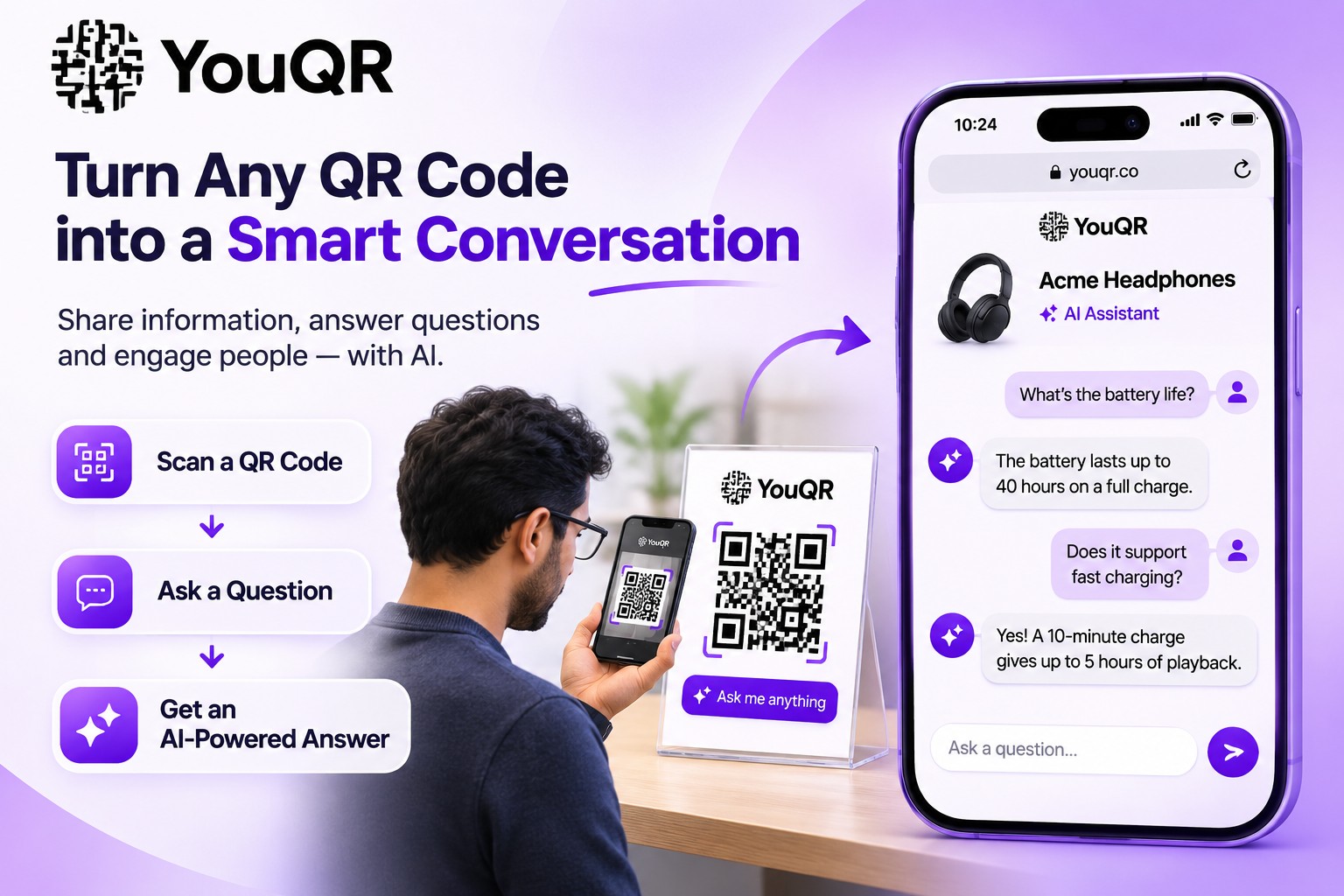
A newer kind of QR code skips the page entirely and lets you ask a question directly. Instead of linking to a document, it links to a simple AI conversation that’s been given the specific information for that one thing: that holiday let, that menu, that surf school’s tide times and gear list. You scan it, type “is there a cot I can borrow” or “what time does the kitchen stop serving,” and you get a direct answer pulled from what the owner actually provided, rather than a document you have to search through yourself.
One example of this is a tool called YouQR, which lets a business or host upload their own information (a menu, a welcome guide, a set of FAQs) and generates a QR code that visitors can scan and question without installing anything. The answers are limited to what’s actually been uploaded, with guardrails to stop it wandering off and guessing, so it’s closer to a well-organised FAQ you can talk to than a general chatbot.
Where this fits for a trip to Newquay
Think about how many small, repetitive questions a visitor to a seaside town actually has. Is this beach dog-friendly after 10am in summer. Does the cottage have a stairgate. What’s the cancellation policy if the surf lesson gets blown out. None of these need a phone call, and most of them already have a correct answer sitting in an email, a PDF, or a host’s head. A code that can answer directly just closes the gap between the question and the answer that already exists.
For local accommodation, restaurants, and activity providers around Newquay, that’s a fairly ordinary problem: the same questions, over and over, outside office hours, from guests who’d rather not wait for a reply. Setting up a code like this is one way to let visitors help themselves without anyone sitting by the phone on a Saturday evening.
It’s not a replacement for the real thing
Worth being honest about the limits here. A tool like this only knows what it’s been given. It won’t know anything a host hasn’t uploaded, and it shouldn’t be the only way to reach someone if something goes properly wrong, like a boiler breaking at midnight. It’s best suited to the ordinary, predictable questions that make up most of the messages a holiday let or restaurant actually gets, not as a substitute for a real person when it matters.
Worth watching
QR codes aren’t going away from menus, welcome packs, and attraction boards around Newquay any time soon. What’s changing is what happens after you scan one. If you start noticing codes that invite you to ask a question instead of just opening a page, that’s this shift happening in real time, and it’s a small but genuinely useful change for anyone travelling with more questions than time to find the answers.
If you run a holiday let, café, or activity business in Newquay and recognise the “same three questions every week” problem, it’s worth a look at youqr.co to see whether it fits how your guests actually get in touch.